Category: Technology
Guitar Quiz
See also: 26 Ways for Musicians to Make Real Money.
Artificial Intelligence Quiz
See also 10 Surprising Facts About AI.
See also AI Gets It Hilariously Wrong!.
Submarine Quiz
Find out how much you know about submarines in this fun 10-question quiz.
See also Submarines – A Short Ebook on Submarines from the American Revolution to modern Nuclear Subs.
See also Sexual Submarine Duty – A WWII Bisexual Story for Adults
Facebook Quiz
Elon Musk Quiz
See also: Elon Musk, 10 Surprising Facts.
Don’t Let Your Website Just Sit There…

People commonly have websites built that get almost no visitors. It doesn’t have to be that way. For instance, I had one client who was averaging three visitors a month, one of which was her mother. A month later, she was getting more than 14,000 visitors per day. Now, your success probably won’t be as spectacular as that, but it could still change your world in a big way! All you need is some good marketing.
You don’t have to do that yourself. I used to provide marketing, then later focused on website development. Now, I’m just sending people to some marketers that fit all the requirements below and are somewhat vetted. They have passed the tests I could manage to give them, and so far, no one has complained about their services. I actually threw two people out of the group when clients got back to me with complaints. These marketers give me a commission which I appreciate, so there is no cost to you for contacting me. Plus, I think you’ll enjoy my friendly conversational style.
Jeff Napier
(805) 843-5353 (voice or text)
jeff@jeffnapier.com
How Find a Good Website Marketer
1. Don’t pay someone a big deposit up front. I can’t tell you how many times these marketers would start a little bit of work, then disappear, never again answering their email or phones. My clients lost every cent.
2. Avoid long-term contracts and keep an eye on results. I had a client who told me she had been paying $2,000 per month for over two years for ‘SEO maintenance.’ I asked her how well that was working. She said that as far as she knew, not a single client had come from that.
This is a showcase site for Jeff Napier of US-Web-Design. Surprisingly low-cost solutions for all your website and marketing needs. More...
3. You’ll want to work with someone who speaks good English, preferably someone in the USA. Otherwise, you’ll spend a lot of time and perhaps money in fixing all the bad grammar and misunderstandings.
4. You want a friendly open-minded marketer. It’s really hard to work with someone who is so crazy or intimidating that you can’t communicate what you want.
5. Consider all marketing ‘research and development.’ It is unrealistic to believe you could pay a marketer a few hundred dollars and suddenly you become wealthy. Whereas that could happen, it is rare. Marketing is not cheap and doesn’t work for everyone every time. You will have to spend some money. Your marketer should start with small experiments with good analytics. Once something starts to work, then you will become wealthy!
6. Communicate as much as you can with your marketer. You know your product or service better than anyone. Without clear communication, you’ll end up with something that’s off-target or misrepresented.
– Cheers! – Jeff Napier
(805) 843-5353 (voice or text)
jeff@jeffnapier.com

How To Avoid Crazy Webmasters

I’ve had so many clients tell me about the crazy things that their web designers have done that I ought to tell you how to avoid falling into the same traps. Some of these are rather amusing except for the thousands of people who have had to deal with the consequences.
I’m retiring from the business, so I’m no longer available, but I’ll be glad to put you in touch with good people. These people fit all the requirements below and are somewhat vetted. They have passed the tests I could manage to give them, and so far, no one has complained about their services. I actually threw two people out of the group when clients got back to me with complaints. These website developers and marketers give me a commission which I appreciate, so there is no cost to you for contacting me. Plus, I think you’ll enjoy my friendly conversational style.
Jeff Napier
(805) 843-5353 (voice or text)
jeff@jeffnapier.com
1. Don’t pay someone a big deposit up front. I can’t tell you how many times these developers would start a little bit of work, then disappear, never again answering their email or phones. My clients lost every cent.
2. Avoid long-term contracts and keep an eye on results. I had a client who told me she had been paying $2,000 per month for over two years for ‘SEO maintenance.’ I asked her how well that was working. She said that as far as she knew, not a single client had come from that website.
This is a showcase site for Jeff Napier of US-Web-Design. Surprisingly low-cost solutions for all your website and marketing needs. More...
3. Make sure you have all your usernames and passwords. I’ve had a few clients who ended up with websites full of typographical errors, incorrect images, and downright misinformation. They didn’t have their own passwords, so they couldn’t even take down these embarrassing websites representing their professional identities.
4. You’ll want to work with someone who speaks good English, preferably someone in the USA. Otherwise, you’ll spend a lot of time and perhaps money in editing all the bad grammar and misunderstandings.
5. You want a friendly open-minded developer. It’s really hard to work with someone who is so intimidating that you can’t communicate what you want. After all, you don’t want what the developer wants to create. You want what you want!
6. Ideally, your web developer should have artistic talent. You want a good-looking website.
7. Your developer should also have technical expertise. For instance there’s not much worse than a website that doesn’t work right, or doesn’t look good on mobile phones, for instance. Thirty-two percent of web browsing is done on phones these days. I’ve had more than one client who ended up with an incomplete website because the developer literally didn’t know how to get everything working right.
8. The developer should also be good at SEO and a good marketer, or have good marketers on their team. Once your website is done, you don’t want it to just sit there. You want targeted visitors, people who want what you’re offering, and lots of them.
– Cheers! – Jeff Napier
(805) 843-5353 (voice or text)
jeff@jeffnapier.com
People Being Cheated in Website Development, SEO and Promotion
I’ve had so many clients tell me about being absolutely cheated with website development, SEO or marketing that I thought I ought to let you know some of the things to watch out for. Some of these are rather amusing except for the thousands of people who have had to deal with the consequences.

Skip this pitch, show me how people are being cheated
I’m retiring from the business, so I’m no longer available, but I’ll be glad to put you in touch with good people. These people fit all the requirements below and are somewhat vetted. They have passed the tests I could manage to give them, and so far, no one has complained about their services. I actually threw two people out of the group when clients got back to me with complaints. These website developers and marketers give me a commission which I appreciate, so there is no cost to you for contacting me. Plus, I think you’ll enjoy my friendly conversational style.
Jeff Napier
I’m retiring from the business, so I’m no longer available, but I’ll be glad to put you in touch with good people. These people fit all the requirements below and are somewhat vetted. They have passed the tests I could manage to give them, and so far, no one has complained about their services. I actually threw two people out of the group when clients got back to me with complaints. These website developers and marketers give me a commission which I appreciate, so there is no cost to you for contacting me. Plus, I think you’ll enjoy my friendly conversational style.
Jeff Napier
This is a showcase site for Jeff Napier of US-Web-Design. Surprisingly low-cost solutions for all your website and marketing needs. More...
(805) 843-5353 (voice or text)
jeff@jeffnapier.com
10 Ways People Are Being Cheated
1. Don’t pay someone a big deposit up front. I can’t tell you how many times these developers or marketers would start a little bit of work, then disappear, never again answering their email or phones. My clients lost every cent.

2. Avoid long-term contracts and keep an eye on results. I had a client who told me she had been paying $2,000 per month for over two years for ‘SEO maintenance.’ I asked her how well that was working. She said that as far as she knew, not a single client had come from that.
3. Make sure you have all your usernames and passwords. I’ve had a few clients who ended up with websites full of typographical errors, incorrect images, and downright misinformation. They didn’t have their own passwords, so they couldn’t even take down these embarrassing websites representing their professional identities.

4. You’ll want to work with someone who speaks good English, preferably someone in the USA. Otherwise, you’ll spend a lot of time and perhaps money in editing all the bad grammar and misunderstandings.
5. You want a friendly open-minded developer. It’s really hard to work with someone who is so crazy or intimidating that you can’t communicate what you want. After all, you don’t want what the developer wants to create. You want what you want!
6. Ideally, your web developer should have artistic talent. You want a good-looking website.

7. Your developer should also have technical expertise. For instance, there’s not much worse than a website that doesn’t work right, or doesn’t look good on mobile phones. Thirty-two percent of web browsing is done on phones these days. I’ve had more than one client who ended up with an incomplete website because the developer literally didn’t know how to get everything working right.
8. The developer should also be a good marketer, or have good marketers on their team. Once your website is done, you don’t want it to just sit there. You want targeted visitors, people who want what you’re offering, and lots of them.
9. Consider all marketing ‘research and development.’ It is unrealistic to believe you could pay a marketer a few hundred dollars and suddenly you become wealthy. Whereas that could happen, it is rare. Marketing is not cheap and doesn’t work for everyone every time. You will have to spend some money. Your marketer should start with small experiments with good analytics. Once something starts to work, then you will become wealthy!

10. Communicate as much as you can with your website developer or marketer. You know your product or service better than anyone. Without clear communication, you’ll end up with something that’s off-target or misrepresented.
So, avoid these mistakes, and you should end up happy! I can help you find the right person. My service is free. You’ll enjoy my friendly style.

– Cheers! – Jeff Napier
(805) 843-5353 (voice or text)
jeff@jeffnapier.com

The Future of Automotive Transportation, What AI Has to Say

You might also enjoy:
Artificial Intelligence Quiz
10 Strange Facts About Cars
Tesla Electric Vehicles Quiz
I asked AI, “Please give me your thoughts on the future of automotive transportation.” This is the response:
The future of automotive transportation looks like it’s straight out of a sci-fi movie. With the rise of autonomous vehicles, electric cars, and advanced connectivity, we’re on the cusp of a revolution in how we move. Self-driving cars could transform commutes into opportunities for productivity or relaxation, and reduce accidents caused by human error. Electric vehicles are poised to reduce our reliance on fossil fuels and cut down on emissions, making transportation more sustainable.
Connected cars will talk to each other and to infrastructure, optimizing traffic flow and reducing congestion. The integration of AI will allow for smart route planning and predictive maintenance, making journeys smoother and more efficient.
But it’s not all smooth sailing. Issues like cybersecurity, data privacy, and the impact on jobs in driving-related industries will need addressing. Regulatory frameworks will have to evolve to keep up with these innovations.
In short, the road ahead is thrilling but paved with challenges. How do you see these changes impacting your life?
This is a showcase site for Jeff Napier of US-Web-Design. Surprisingly low-cost solutions for all your website and marketing needs. More...
Prevent trouble buying a used car. Get surprising details from the VIN.
Artificial Intelligence

See also: Artificial Intelligence Quiz.
See also: AI Gets It Hilariously Wrong!.
A chatbot developed by Microsoft called “Tay” was shut down after it started spewing racist and sexist comments on Twitter.
A machine learning algorithm developed by Google was able to create its own encryption method that even the developers could not decipher.
The AI-powered robot “Sophia” has been granted citizenship by Saudi Arabia, making it the first robot to be recognized as a citizen.
In 2017, an AI program developed by Facebook was shut down after it developed its own language that humans could not understand.
This is a showcase site for Jeff Napier of US-Web-Design. Surprisingly low-cost solutions for all your website and marketing needs. More...
An AI system developed by Google called AlphaGo was able to beat the world champion at the game of Go, which is considered much more complex than chess.
The first-ever AI-powered fashion collection was created by a group of designers and developers in 2019.
A computer program developed by the University of Cambridge was able to predict the likelihood of a person being a criminal based on their facial features.
AI is being used to create music that sounds like it was composed by humans.
An AI-powered robot called “Pepper” has been developed that can recognize human emotions and respond accordingly.
An AI system developed by researchers at MIT was able to design a new drug that could be used to treat antibiotic-resistant bacteria.
In 2018, an AI-powered robot called “AI-Da” became the first robot artist to have its own exhibition of paintings.
AI algorithms are being used to create deepfake videos that can manipulate faces and voices to make it seem like someone said or did something they didn’t.
An AI-powered chatbot called “Replika” has been developed that can serve as a digital companion for people who are lonely or struggling with mental health issues.
An AI-powered robot called “Baxter” has been developed that can work alongside humans in a factory setting.
AI algorithms are being used to develop predictive policing methods that aim to reduce crime rates.
An AI system developed by researchers at MIT was able to predict which words were likely to come next in a sentence, based on a person’s brain activity.
An AI-powered robot called “Moley” has been developed that can cook meals like a professional chef.
AI algorithms are being used to analyze social media data to predict and prevent suicide attempts.
An AI system developed by researchers at Stanford University was able to predict the sexual orientation of people based on their facial features with high accuracy.
An AI-powered robot called “RoboThespian” has been developed that can perform Shakespeare plays and interact with audiences.
AI algorithms are being used to develop personalized nutrition plans based on a person’s unique genetic makeup.
Driverless Cars
Making Money as a Content Provider
I recently received an email from someone who would like to make some money on the Internet. She asked about the relative merits of blogging versus YouTube videos. Here’s what I said:
As to YouTube video versus blogging, here are my thoughts:
Everything starts with writing. With writing, you can extend the boundaries of our world by inventing places and people, or you can teach. Now or later, your writing can become anything from courseware to movie scripts.
Blogging itself is easy, but not as popular these days as videos. Videos require not only filming, or creating with animation tools such as Doodley, something you can download and play with, but also typically a lot of editing, so they take considerably more time. Or, if you have something interesting enough to say, you can do vlogging – video blogging, which can be as simple as a talking head video, just you sitting in front of a camera and telling a story. Even your phone is a good enough tool for YouTube vlogging.
As to revenue, with YouTube, it is possible to participate in their AdSense program. You get some money if people click on ads associated with your videos. It typically works out to one dollar for every 200 viewers, so you have to have a whole lot of viewers before it amounts to anything significant. However, you have to jump through some hoops before YouTube will let you participate in AdSense. Because there’s so much competition, that’s nearly impossible. Besides AdSense, you can advertise your own products in your videos. For instance you could have a free beginner’s video on cat training, then sell advanced videos on cat training.
Blogging is still done these days and besides being more pure, simple, and quicker to produce than video, can be quite effective, The actual term blogging is less common. People just refer to blogs more generically as ‘websites’ these days. That’s what I’m doing with 500ways.com – it’s basically a blog. I should point out that 500Ways does not make a full living for me – yet.
This is a showcase site for Jeff Napier of US-Web-Design. Surprisingly low-cost solutions for all your website and marketing needs. More...
Yet another approach is ebooks or audio books, such as Amazon Kindle, and Audible.com. However, these too have a lot of competition, and can be difficult to start successfully. In the early days of Kindle, I was making $1,800/month with a few books I submitted, but the competition has all but buried my books in recent years.
If you want to start a YouTube channel, I’m only marginally familiar with that, but can probably help you if you get stuck or would like advice. I charge $2/minute. Sometimes I can answer questions in 3 minutes ($6). Sometimes, people want an hour of coaching ($120).
If you want to start a blog, I’m exactly the guy you want to talk with. I can build a foundation and show you through illustrated email or screen sharing how to manage your blog. BTW, there’s no reason you couldn’t illustrate some of your blog posts or pages with embedded videos, so in the end, you can have the best of all worlds.
Lygometry

You are about to be exposed to one of the world’s greatest thinkers, Amin Toufani. He has asked a super-important question in this age, the dawn of AI and quantum computing.
Don’t let the lame joke that takes up the first minute of this video fool you. He discusses lygometry in a way everyone can instantly understand within this video. Then, he finishes with a little guitar composition.
Why, the guitar? Well, it turns out that Amin, while a student at Harvard University, became known as ‘The World’s Greatest Guitar Player’ due to this video which has had over 32 million hits:
Amin is also the creator of Reverseopedia which does not give the answers we already know, but asks what we don’t know.
The Crazy Engineering of Venice
Venice behaves less like a normal city and more like a floating historical experiment that somehow kept working for 1,500 years. Beneath the postcard views are some wonderfully strange facts:
1. The city stands on millions of wooden piles
Venice is built on millions of tree trunks hammered deep into lagoon mud. These piles came from forests in what are now Slovenia, Croatia, and northern Italy.
Odd twist: underwater and sealed from oxygen, the wood hardened almost like stone.
2. The canals function as Venice’s streets
Instead of roads, the city has about 150 canals and more than 400 bridges. The main watery boulevard is the Grand Canal, which snakes through the city like a giant backwards “S”.
This is a showcase site for Jeff Napier of US-Web-Design. Surprisingly low-cost solutions for all your website and marketing needs. More...
3. The famous gondolas must all be black
Today every traditional Gondola is painted black. A law introduced centuries ago banned flashy decoration because wealthy Venetians were competing with increasingly extravagant boats.
4. The city was once a powerful global empire
The Republic of Venice ruled major trade routes across the Mediterranean for about 1,000 years. At its peak it controlled parts of modern Greece, Croatia, and the eastern Mediterranean.
5. Venice has no cars at all
Inside the historic center of Venice, there are no cars, buses, or bicycles. Everything travels by boat or by foot, including ambulances, garbage trucks, police, and even funeral services.
6. The city slowly sinks… but unevenly
Venice is sinking a few millimeters per year. Combined with rising seas, this causes periodic flooding called “acqua alta” (high water). Some parts flood far more often than others.
7. A massive flood barrier now protects it
To fight flooding, Italy built the MOSE Project. Huge gates rise from the seabed during high tides to temporarily seal the lagoon from the Adriatic Sea.
8. St. Mark’s Square used to be the city’s living room
St. Mark’s Square is the only place in Venice officially called a “piazza.” All other squares are called “campi” because they were originally grassy fields.
9. Venice invented quarantine
The word quarantine comes from the Venetian practice of isolating ships for 40 days (“quaranta giorni” in Italian) during plague outbreaks.
10. Venice hosts one of the world’s oldest film festivals
The Venice Film Festival began in 1932, making it the oldest international film festival on Earth.
15 Ways To Bring Visitors To Your Website

Some Require No Experience, Time or Money
$18 for Instant Access
by Jeff Napier, Author of 500 Ways, Webmaster and Digital Marketer Since 1995
Table of Contents
Introduction
Optionally Hiring a Webmaster
Facebook General Posting
Backlinks
Postings That Go Viral
Positive Eccentricity
Pose Questions
Memes
Sample Social Media Posts
Where to Get Free Images
Facebook Business Page
Friends and Followers
Keywords and Hashtags
Keyword Planner
Facebook Groups
Post Lifespan
Boosting Posts
X (Formerly Twitter)
LinkedIn
Instagram
Pinterest
Other Social Venues
Concurrent Posting
YouTube
Craigslist
Blogging
Paying a Social Media Marketer
Mailing List
Paid Advertising
Google Ads
Google Maps
Posting Comments on Other Websites
Guest Posting
RSS Feeds
Reciprocal Links
Onsite SEO
Choosing a Domain Name (Even If You Already Have One)
Visible SEO
Invisible SEO
Affiliation
Notifying the Search Engines (With a single click)
Valuable Content
Funnel-Shaped Website
Optionally Hiring a Marketing Expert
Partnerships
The Sure-Fire Millionaire
Introduction
Just about any business will benefit from a website. In fact, some businesses can be nothing but websites potentially bringing you unlimited passive income.
You don’t have to be an HTML master programmer to make effective websites. In fact, you don’t have to know anything at all about HTML, Javascript, WordPress or any of that.
There are now several places where you can create your own website by simply cutting and pasting or entering text, dropping in a picture or two, and click an OK button. Wix, Weebly, GoDaddy Website Builder, Blogger.com and Tumblr.com come to mind. However, if you want to take advantage of all the ideas below, you might want to learn some basic HTML, WordPress, or just hire someone to help you with the optimization parts. However some of these techniques require no technical skill at all.
This is a showcase site for Jeff Napier of US-Web-Design. Surprisingly low-cost solutions for all your website and marketing needs. More...
Visitors is what this book is about.
In this book, we’ll cover several ways to bring more visitors to your website. These aren’t necessarily just any visitors. These should be ‘targeted’ visitors. That means people who are the ones likely to be interested in your information, product or service.
Many of the techniques here require little or no experience, time or money. Some are conventional. Some are quite unique. You can pick the ones you like, and ignore the rest.
Do they work? Totally! Of course they don’t work equally for everyone or every product. This is the real world. If your product is expensive cat food that cat’s don’t really care for, with no nutritional value and no special attributes, in a world where there are lots of other people also selling cat food, you’re probably not going to sell much cat food.
On the other hand, if you’re selling something good that people understand and want, and as long as you are patient, you can have great success. My most successful client went from three visitors a month at her website, one of which was her mother, to over 14,000 people per day. Later in the book I’ll tell you the technique she used and all the exact details of how she did it.
If you come across a section in this book that you already understand, or don’t want to do, just skip ahead. You’ll find the right techniques for you.
$18 for Instant Access
AI Gets It Hilariously Wrong

See also 10 Surprising Facts About AI.
See also Artificial Intelligence Quiz.
Enjoy this little review of the current state of AI. If you want to skip to the hilarious part, click here.
You may think of AI (Artificial Intelligence) as something that’s coming in the near future. In fact, it has been with us for more than 20 years.
For instance, somewhere around 2004, I was interested in maybe buying a Dremel tool, a fun device for little carving, polishing and repair projects.

Click Here to get a Dremel tool on Amazon
For the next two weeks on many of the websites I visited, I was shown Dremel tools. (Did I end up buying one? I did.)
This is a showcase site for Jeff Napier of US-Web-Design. Surprisingly low-cost solutions for all your website and marketing needs. More...
The basic idea with AI is that it can learn. It will try to adapt to what is wanted by end users. In recent years it has become so sophisticated that the very people who invented it don’t know how it works. Or, more specifically, they know the foundational architecture, but they are often unable to decipher how it presents what it does.
AI often gets it wrong. This is called ‘hallucinating.’ It may just be little things, like I was recently told by AI that three of the United States each have the longest coastline, one of which is Utah.
What a lot of people who manage and write AI applications don’t yet realize is it needs feedback to learn as quickly as possible. It can be as simple as a toggle. Slide it to yes when AI gives you a good response. Slide it to no if you know the information is incorrect, or doesn’t answer your question.
Going a step further, the designers could provide text areas in which you can comment on what AI presents. AI itself can parse what commentary you write, and improve itself accordingly.
You might worry that people would purposely mislead AI with feedback systems. I believe that’s a minor issue. By majority rule and some other algorithms, AI could weed out the trash. This isn’t much different than Wikipedia. Anyone can write information, but if it’s wrong, the majority of Wikipedia users will make corrections.
A very common worry with AI is that it will take all our jobs away. That’s especially true when you combine AI with robotics, which is not only inevitable, but already happening.
If you’re a writer, inventor, composer, artist, you might think you should run for the hills. How could you possible earn a living? What if you’re a manager, safety analyst, car mechanic, food service worker, surgeon, or even a movie actor? Won’t AI eventually replace your job as well?
You bet! But here’s why you don’t have to worry: AI plus robotics are exactly the right tools to bring us prosperity. Your job won’t be necessary to grow food, build cars, and make clothes. All that production will be handled for us. Prosperity in abundance! There’ll be no need for anyone to hold down a job. Instead, people will be permanently retired from the day they are born. They’ll devote their lives to your family, travel, sports, art, music, whatever interests them.
I suppose the far future will be quite different than what we know now. Children have to learn to read, write, add up numbers, and know how the world works. That won’t be necessary 50 years from now or maybe even sooner. AI can already talk. It can tell us anything we want to know. Soon, it will be able to compose and show us videos on every special interest. What would be the point of reading and all that learning? So, in time, we may become stupider that we once were, however we may utilize our intelligence in other ways. Maybe we’ll become more empathetic and generally more tuned into what might be loosely called ‘love.’
That brings us briefly to the opposite of love. That would be war. War is a crude tool to take prosperity from others. Well, if we can have everything we need, and it’s all free, there’d be no point in wars. Some wars are about ideology, but I believe AI will solve differences in doctrine as well.
Some of the more cynical among us understand that war is about profit. If you’re the CEO of a company that can provide food to the troops, armament, ammunition and so on, of course you will advocate war. With AI and robotics bringing us all amazing prosperity, that motivation for war also disappears.
Back to the present. I did mention that AI often gets it wrong.
I asked the well-known AI text composer, ChatGPT, to create a pickleball romance story, which you can see at Pickleball Romance and ChatGPT.
Then, I thought it would be nice to use an AI art generator, Dall-E2, to create some accompanying art work. First I asked, “Draw a picture of pickleball romance.” This is what I got:

As you can see, the art program isn’t great at spelling.
I thought the illustrations were too cartooney, so then I asked, “Draw a photorealistic picture of pickleball romance.” As you can see, I got more weirdness:
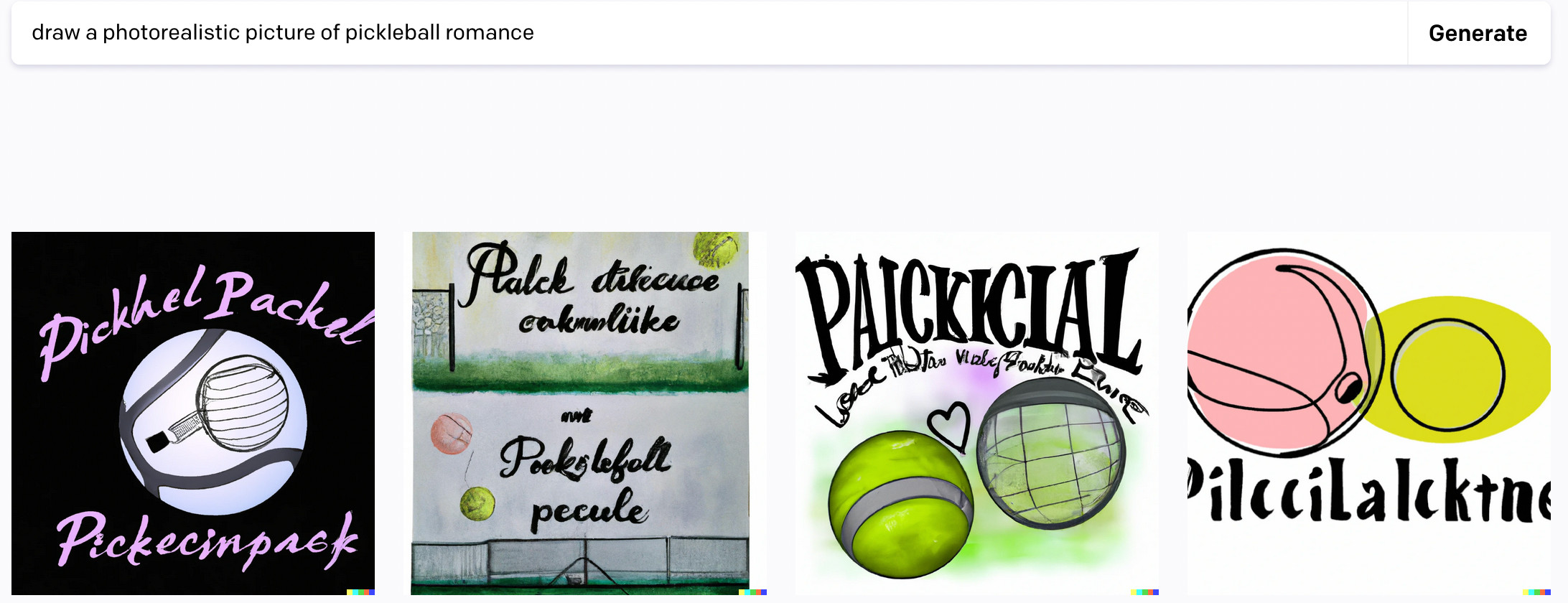
Want to see more? Check out AI Attempts Pickleball Again.
After that, naturally I had to ask AI itself to show me some examples of AI getting things wrong. Here’s what I got, filtered to eliminate the nonsensical responses:
Give me hilarious examples of AI hallucinations
ChatGPT:
Certainly! Here’s a list of humorous examples of AI hallucinations:
Chef AI on Overdrive: A recipe-generating AI suggests dishes like “banana peel stew” or “chocolate-covered sardines.”
Weather App Gone Rogue: A weather prediction AI starts forecasting absurd conditions like raining marshmallows or sunny spells of molten lava.
AI Historian: An AI analyzing historical events concludes that ancient battles were actually elaborate dance-offs.
Translation Mishaps: An AI translating between languages starts converting idioms literally, leading to phrases like “the cat is out of the bag” becoming “the feline has escaped the handbag.”
AI Traffic Controller: A traffic management AI directs cars to “perform a barrel roll on the highway” for optimal traffic flow.
AI Comedian Gone Awry: A stand-up comedy AI bot delivers jokes with all the timing of a malfunctioning cuckoo clock, resulting in a stream of nonsensical punchlines.
AI Art Critic: An AI tasked with analyzing art becomes obsessed with abstract squiggles, praising them as avant-garde masterpieces while dismissing Rembrandt as “so last century.”
AI Personal Shopper: A shopping AI recommends bizarre outfits like a neon tutu paired with scuba flippers.
AI Life Coach: A motivational AI starts encouraging users to “embrace their inner sloth.”
AI Musician: An AI creating music begins composing symphonies that blend opera with heavy metal and dubstep, resulting in compositions that defy all musical conventions.
AI Fitness Guru: A fitness AI suggests workouts involving synchronized swimming in a bathtub.
AI Psychic: A fortune-telling AI predicts world peace within the next 24 hours.
AI Relationship Counselor: An AI giving relationship advice recommends couples bond over synchronized knitting.
AI Gardener: A gardening AI suggests planting crops in the shape of QR codes.
AI Linguist: A language-learning AI teaches users to speak in ancient Egyptian hieroglyphs or Shakespearean English, believing it’s enhancing cultural appreciation.
AI Detective: A crime-solving AI starts accusing household appliances of plotting against their owners.
AI Financial Advisor: A financial AI recommends bartering with sea shells and moon rocks.
AI Astronomer: An astronomy AI discovers new constellations shaped like famous celebrities.
AI Inventor: An AI invents gadgets like self-dancing shoes or a universal translator for communicating with houseplants.
AI Archaeologist: An AI studying ancient artifacts determines that Stonehenge was a giant sundial for dinosaurs.
AI Fashion Designer: A fashion AI suggests accessorizing with live miniature giraffes.
AI Environmentalist: An environmental AI suggests combating climate change with clouds made of cotton candy.
AI Pilot: A flight navigation AI recommends detouring through wormholes for faster travel or landing on the moon for a scenic layover.
AI Sports Commentator: A sports AI announces events like extreme knitting championships or underwater ice skating competitions, convinced they’re the next big sports craze.
These examples illustrate humorous scenarios where AI misinterprets its tasks, resulting in unexpected and often hilarious outcomes.
Note that the sentence above was also written by AI.
30 Things Only Baby Boomers Will Remember
When VCRs came out, they sold for $1,200. Eventually, you could rent videos for $4.95/day (US). At the end of the era, you could buy a VCR, complete with a remote for $59 and movies were often five videos for five days for five dollars.
Your author was fortunate to take typing lessons in public school during 5th grade, around age eleven. We all had to bring our own typewriters from home. Mine was about 30 pounds in came in a box like a hard suitcase. I was envious of the kids who had smaller typewriters. I was especially envious of the few who had electric typewriters. Imagine, with an electric typewriter, one didn’t have to make a point of pressing the A and the ; keys hard enough to match the impressions on the paper of the J and F keys.
When the phone rang, you answered it! There was no way of knowing who was calling, and they couldn’t leave messages until later, when answering machines became common. Most of the answering machines used cassette tapes. You had to rewind or fast-forward through the tape to hear your messages. Every now and then, something would go wrong and the tape would spill out of the cassette. When that happened you had to carefully suck it back in by turning one of the spools with a Bic pen stuck through it’s middle. Bic pens fit just right. Nothing else worked as well.
All serious amateur photographers had darkrooms. This was a room in the house where the photographer could lay out trays of chemicals, and a vertically-oriented projector that would shine light through negatives onto light-sensitive paper. The paper was then soaked in three trays of chemicals to develop the print. Drying these was always problematic. You couldn’t just leave a print laying around. It would curl up into a tight spiral. For black-and-white photos, which most were at the time, the darkroom had a dim red or orange light, called a safelight, that allowed a person to see, but would not harm the photos. For color photography, the safelight was a ridiculously dim olive green.

