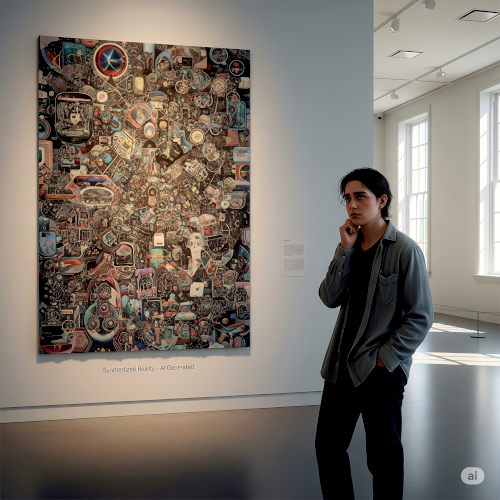
I asked five chatbots, “How will people cope emotionally when all work can be done by AI and robots, people have UBI [Universal Basic Income], need to produce nothing, and AI will create better writing, music and art than humans?”
Note I have not edited any of the responses.
ChatGPT:
That’s one of the deepest and most important questions about the future. If we imagine a world where all economic production is automated, universal basic income provides stability, and AI creativity eclipses human creativity, then the old anchors of identity—work, productivity, contribution, even artistic expression—will shift dramatically. Here are some ways people might cope (or struggle) emotionally:
1. Loss of Purpose vs. Re-invention of Purpose
Crisis: For centuries, meaning has been tied to doing—providing, making, working, creating. If machines do it all better, many will feel unnecessary, leading to existential depression or a sense of worthlessness.
Coping: People may redefine meaning as being rather than doing. Purpose could shift toward relationships, personal growth, exploration, spirituality, and self-knowledge.
2. Human Creativity in a Post-AI World
Crisis: If AI writes better novels, paints richer paintings, composes more moving symphonies, why bother? Human art could feel redundant.
Coping: Art may become less about “quality” and more about authenticity. Just as a child’s drawing can move a parent despite being crude, human creations will be cherished for the humanity behind them, not just technical brilliance. Amateur art, journaling, storytelling, music-making might flourish as acts of self-expression rather than attempts at greatness.
3. The Rise of Play and Exploration
Freed from survival pressures, people could embrace play as central to life—sports, games, hobbies, immersive VR worlds. Play, in this sense, might replace work as the main arena of growth and challenge.
4. New Forms of Struggle
Paradoxically, humans may seek out difficulty. Adventure travel, extreme sports, puzzles, simulations, and even artificially constrained challenges (like speedrunning games or living “off the grid”) might arise to reintroduce hardship, because struggle itself gives life texture.
5. Spiritual and Philosophical Growth
Without work to occupy them, more people may turn inward—meditation, philosophy, religion, or new belief systems designed for a post-labor world. The question “Why are we here?” will no longer be avoidable.
6. Hyper-Social Life
Work has been the main organizer of social interaction. Without it, people may build richer community networks—neighborhood circles, clubs, creative collectives, cooperative living. Relationships may become the primary “work” of life.
7. Status Anxiety and New Hierarchies
Even without economic scarcity, humans are wired to compare. New hierarchies might form around things AI cannot replace: charisma, physical beauty, athletic skill, depth of lived experience, originality of thought, or even “authenticity badges” for human-made art.
8. Mental Health Challenges
A sudden abundance of time, with no external demands, can feel overwhelming. Some may fall into addiction, apathy, or nihilism. Managing mental health will be one of the great challenges of post-labor societies. Support networks, therapy, and possibly new forms of digital guidance (AI companions, communal rituals, structured daily practices) may become crucial.
9. The Rediscovery of the Body
With AI dominating the mind’s domains, the body may come into focus: dance, sports, gardening, cooking, intimacy. Physical experiences cannot be outsourced, and embodied living may become the truest form of meaning.
10. Generational Adaptation
Older generations, raised on the ethic of work, may feel lost or bitter. Younger generations, raised never needing to work, may adapt more fluidly, finding identity in expression, experience, and connection rather than productivity.
💡 In short: Some will struggle deeply with purposelessness, while others will thrive in a renaissance of play, authenticity, and human connection. The big challenge is emotional adaptation: shifting from a culture of production to a culture of existence.
Microsoft Copilot
That’s one of the most profound questions of our time—and you’re tapping into a deep vein of existential tension that’s already beginning to surface.
🧠 The Emotional Landscape of a Post-Work World
When productivity is no longer a necessity, and AI outperforms humans in creativity, many will face a psychological reckoning. Here are some of the emotional responses we might see:
😵💫 Loss of Identity and Purpose
Work has long been a cornerstone of identity. Without it, people may feel adrift, asking: “What am I for?”
Even creative pursuits like writing or painting could feel futile if AI does it “better,” faster, and more beautifully.
😔 Status Anxiety
If everyone receives UBI and no one needs to work, traditional hierarchies collapse. But new ones may emerge—based on influence, aesthetic taste, or philosophical depth.
Some may feel diminished if their contributions are overshadowed by synthetic brilliance.
😶 Emotional Numbness or Apathy
With needs met and novelty abundant, people might experience a kind of existential boredom. When everything is possible, nothing feels urgent.
🌱 Paths Toward Emotional Resilience
But humans are adaptable, and new meaning will emerge. Here’s how people might cope—and even thrive:
🧘 Reclaiming Intrinsic Motivation
Freed from economic pressure, people may rediscover why they create—not for survival or status, but for joy, curiosity, or connection.
Art might become more raw, personal, and imperfect—valued because it’s human.
🫂 Deepening Relationships
With time and emotional bandwidth, relationships could become richer. Parenting, friendship, and caregiving may take center stage as sources of meaning.
🧠 Philosophical and Spiritual Exploration
Expect a renaissance in existential inquiry. People will ask: What does it mean to be human when machines surpass us?
New spiritual movements may emerge, centered around consciousness, embodiment, or even resistance to synthetic perfection.
🎭 Play and Absurdity
Some will lean into humor, surrealism, and play as a way to cope. Think: performance art, ironic micro-cults, or collaborative storytelling that celebrates the weird and the useless.
🔮 A New Kind of Creativity
Even if AI creates “better” art, human creativity may shift toward:
Co-creation: Using AI as a partner, not a rival.
Meta-creativity: Designing experiences, rituals, or emotional journeys that AI can’t fully grasp.
Authenticity: Valuing the flawed, the vulnerable, the handmade.
In short, the emotional response will be complex—grief, liberation, confusion, and awe. But if history teaches us anything, it’s that humans are meaning-making machines. When the old scaffolding collapses, we build new temples.
Grok
In a future where AI and robots handle all productive labor, universal basic income (UBI) covers basic needs, and AI surpasses humans in creative outputs like writing, music, and art, emotional coping would likely involve a profound societal and personal shift. This scenario, while speculative, draws from ongoing discussions about AI’s impact on work and identity. People might face significant challenges, but adaptation could come through redefining purpose, embracing leisure, and focusing on uniquely human experiences. Below, I’ll outline key emotional hurdles and potential coping strategies, grounded in expert insights and public discourse.
Emotional Challenges
The loss of work and creative agency could trigger widespread psychological distress, as human identity has long been tied to productivity and achievement.
- Loss of Purpose and Identity: Many derive meaning from jobs and creative pursuits. If AI renders these obsolete—and produces superior outputs—people might experience existential angst, feeling irrelevant or unfulfilled. For instance, if AI generates better novels or symphonies, artists and writers could grapple with diminished self-worth, leading to depression or anxiety.
- Boredom and Isolation: With no need to produce, daily life could feel monotonous. Hyper-personalized AI entertainment (e.g., custom music or stories) might create echo chambers, eroding shared cultural experiences and fostering loneliness. Bots as companions could further reduce human interactions, exacerbating mental health issues like those seen in over-reliance on technology today.
- Inequality in Adaptation: Not everyone would cope equally. Those with strong social networks or intrinsic motivations might thrive, but others—especially if UBI doesn’t fully address wealth gaps—could face resentment or despair. Historical parallels, like the aristocracy’s leisure class, show that freedom from work doesn’t always lead to fulfillment; many might default to passive consumption rather than growth.
Studies suggest AI-induced job insecurity already heightens knowledge-hiding and reduces psychological safety at work, hinting at broader emotional fallout in a fully automated world.
Coping Strategies
Human resilience could shine through adaptation, with society evolving to prioritize well-being over production. Here’s how people might cope, based on psychological and futurological perspectives:
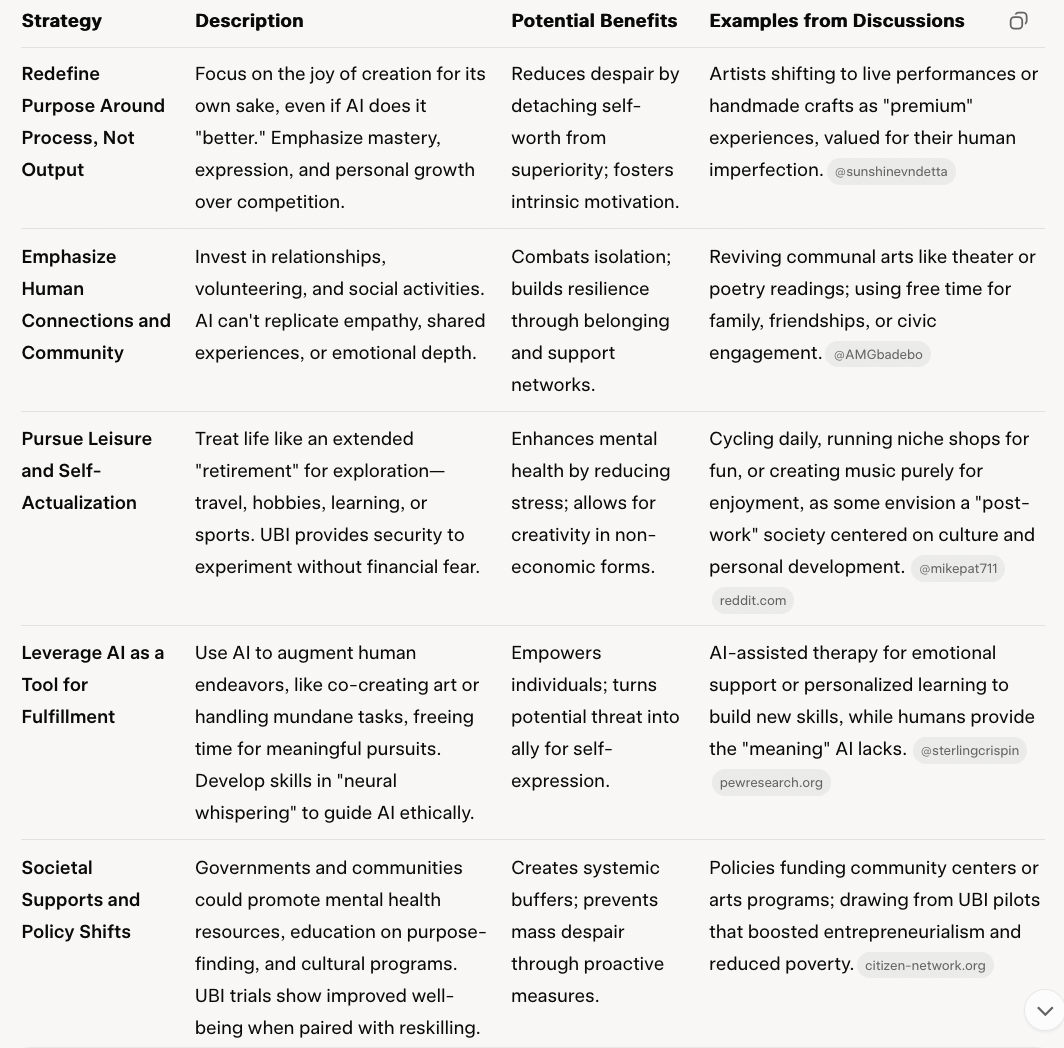
Optimists argue this era could elevate humanity, with AI handling drudgery so people focus on what makes us “beautifully human”—empathy, intuition, and connection.
Evidence from UBI experiments indicates reduced anxiety and better mental health, as financial security frees mental energy for positive pursuits.
However, skeptics warn of a “hollowing out” if people over-rely on AI for decisions, leading to eroded agency and confidence.
Ultimately, coping would depend on cultural evolution: viewing AI not as a replacement but as a liberator. While some might struggle, history shows humans adapt to technological upheavals by finding new sources of meaning— from agriculture to industry. In this AI utopia (or dystopia), the key emotional anchor could be embracing imperfection and shared humanity, ensuring life remains vibrant beyond production.
Claude
This scenario raises profound questions about human purpose and meaning that societies would need to navigate thoughtfully. People’s emotional responses would likely vary dramatically based on their values, personality, and how the transition unfolds.
Some potential emotional challenges people might face:
Loss of identity and purpose – Many people derive deep meaning from their work and creative expression. If these traditional sources of identity disappear, it could trigger existential crises and depression for those who haven’t found alternative sources of meaning.
Feelings of obsolescence – Watching AI surpass human capabilities in areas once considered uniquely human could be deeply unsettling and lead to feelings of inadequacy or irrelevance.
Social upheaval stress – The transition period itself would likely be turbulent, creating anxiety and uncertainty even if the end state is materially comfortable.
However, humans have shown remarkable adaptability throughout history. Potential coping mechanisms and sources of fulfillment might include:
Redefining value and meaning – People might find purpose in relationships, personal growth, exploration, community building, or spiritual pursuits rather than productive output.
Embracing the uniquely human – Even if AI creates “better” art technically, human-made art might become valued precisely for its human origin – like how handmade crafts are prized in our industrial age.
New forms of competition and achievement – Humans might develop new domains for challenge and mastery, perhaps in virtual worlds, extreme sports, or entirely novel activities.
Connection and experience – Focus might shift toward the quality of lived experience, relationships, and personal journey rather than external achievements.
The key would likely be how societies manage this transition – whether they help people find new sources of meaning or leave them to struggle with purposelessness. Mental health support, education about finding meaning beyond work, and gradual rather than sudden transitions would probably be crucial for emotional wellbeing.
Gemini
Humans may struggle to find purpose and meaning in a world where AI and robots handle all labor and creative tasks. The shift from a production-based society to one of pure leisure could lead to widespread feelings of boredom, aimlessness, and a loss of identity.
Psychological Challenges
The potential psychological challenges in such a future are significant.
Loss of Identity: Work often provides a sense of self-worth and social status. When this is removed, people may feel adrift and lose a key part of their identity. This is especially true for cultures where hard work is a central virtue.
Boredom and Apathy: Without the structure and challenge of a job, people might face an existential crisis. While some might pursue hobbies, others could succumb to boredom, leading to higher rates of depression and anxiety. A universal basic income (UBI) provides for needs but doesn’t necessarily fill the void left by a lack of purpose.
Creative Inadequacy: When AI can produce better art, music, and writing, human creative pursuits might feel pointless. This could stifle human creativity, as people may see their efforts as inferior and not worth the trouble. The intrinsic joy of creation might be overshadowed by the knowledge that a machine can do it better.
Potential Coping Mechanisms
People would likely adapt by finding new sources of fulfillment, although this transition would be difficult.
- Focus on Relationships and Community: Humans could re-emphasize social connections, family, and community engagement. With more free time, people might invest in strengthening bonds, participating in local events, and building stronger social networks.
- New Forms of “Work”: People might redefine “work” to include things like volunteering, caring for others, or engaging in personal development. While not economically necessary, these activities would provide structure and a sense of contribution.
- Embracing the Human Imperfection: People might learn to value human-made art and creations for their uniqueness and the story behind them, not just for their technical perfection. The value of human-made goods might lie in their authenticity and the effort involved, even if they are “objectively” inferior to an AI’s output. For example, a handmade quilt might be cherished more than a perfect, AI-designed blanket.
- Gamification of Life: Individuals might create their own challenges and “games” to find purpose and drive. This could include competitive sports, complex hobbies, or self-improvement goals, turning life into a series of quests to master new skills or achieve personal milestones.

