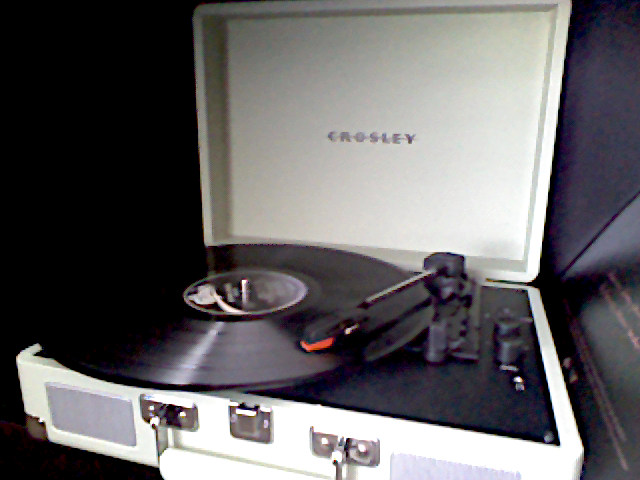
If you look closely, you can see where the loud parts are. Big, wide grooves usually mean louder music. Quiet sections look tighter and more compact.
The grooves are read sideways, not up and down. Most sound is encoded in side-to-side motion of the groove, not vertical bumps.
They’re technically analog time travel. The groove is a physical imprint of past sound waves, like fossilized music.
Records can be played backwards, literally going back in time. This is called ‘backmasking.’ Spin one in reverse and you get eerie, often unintelligible audio that inspired decades of conspiracy theories. Here are two examples:
Led Zeppelin: “Stairway to Heaven” (1970s–1980s)
The Claim: Fundamentalist groups in the 1980s asserted that a section of the 1971 classic contained backwards messages praising Satan.
The “Message”: When played in reverse, the passage “If there’s a bustle in your hedgerow, don’t be alarmed now…” was said to reveal: “Here’s to my sweet Satan. No other made a path, though it makes me sad. Whose power is Satan.”.
Judas Priest: Stained Class Lawsuit (1990)
The Claim: The band was sued by the families of two teenagers who attempted suicide in 1985, alleging that the album contained a backward message saying “Do it”.
The Outcome: The band testified that any message was coincidental noise, and lead singer Rob Halford demonstrated that if you look for a backward message, you can find anything—playing a part of their music that sounded like “I asked her for a peppermint.”
Electric Light Orchestra (ELO): Eldorado (1974)
The Claim: Christian groups claimed the title track contained “nasty” reversed satanic messages, encouraging fans to burn their records.
The Reaction: ELO denied the claim but later embraced the conspiracy. They inserted a deliberate message on their next album (Face the Music, 1975), which starts with a recording of the lyrics to “Fire on High” played in reverse, saying: “The music is reversible but time is not. Turn back. Turn back. Turn back.”.
The Beatles actually used reverse audio for artistic purposes, particularly on “Rain” (1966), where John Lennon’s vocals were played backward at the end of the track. He said he discovered the effect by accident.
There’s usually a “runout groove” at the end where the stylus loops silently forever.
Some records have hidden messages etched into that runout. Little jokes, signatures, or cryptic phrases from engineers live there.
Bass is sneaky on vinyl. Low frequencies are often centered (mono) so the needle doesn’t jump out of the groove.
Some records are scented. Novelty pressings have smelled like chocolate, pine, or even motor oil.
Early DJs put coins on the end of tonearms to keep needles tracking in their grooves. That was very DIY solution to skipping, though not exactly gentle on the grooves.
There are records that play from the inside out. Instead of starting at the edge, the needle begins near the center and moves outward.
Some records contain multiple songs in one groove.

