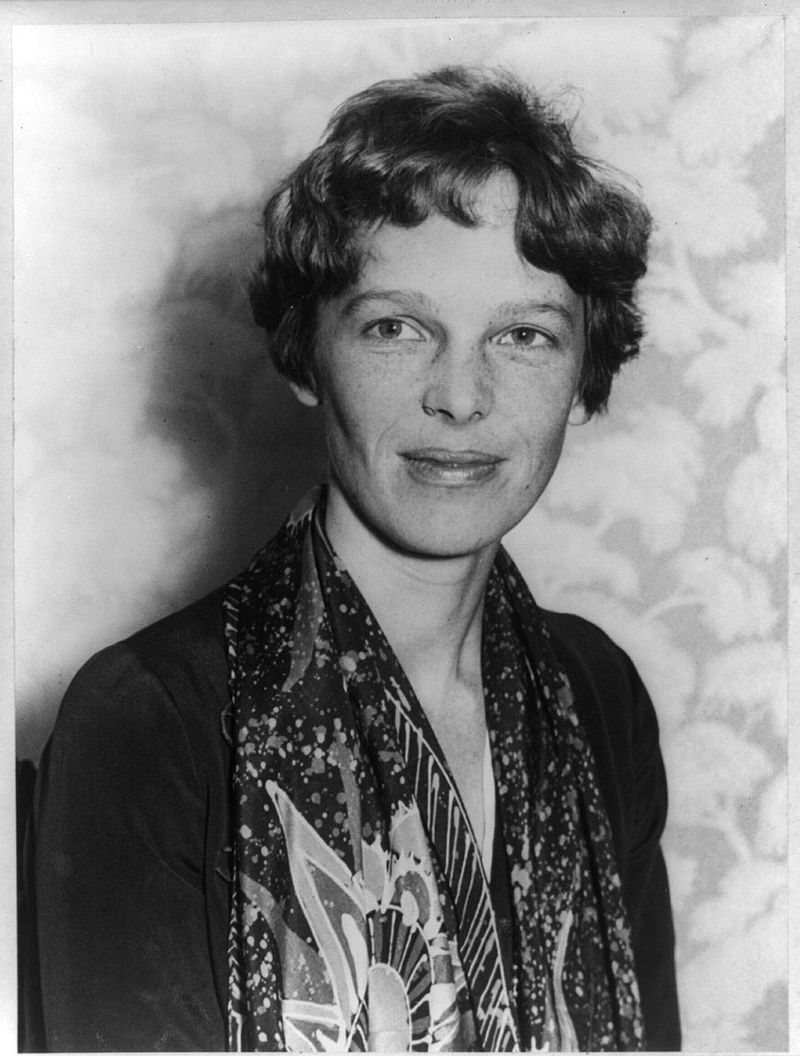
Amelia Earhart: The Sky’s Limitless Spirit
Amelia Mary Earhart was not just an aviator; she was a symbol of courage, innovation, and determination in a time when women were largely confined to traditional roles. Born on July 24, 1897, in Atchison, Kansas, Earhart’s story is as thrilling as the skies she loved to navigate and filled with surprising turns, inspiring milestones, and one of the greatest unsolved mysteries in modern history.
Early Life: A Wild Heart Takes Flight
Amelia’s upbringing was unconventional for a girl in the early 1900s. Her father, Edwin Stanton Earhart, was a railroad lawyer who struggled with alcoholism and job instability, while her mother, Amy, came from a wealthy family and encouraged her daughters to be independent and adventurous. As children, Amelia and her younger sister, Muriel, wore bloomers instead of dresses, climbed trees, hunted rats with rifles, and refused to be boxed in by what society expected of girls.
Surprisingly, Amelia didn’t take her first flight until she was 23 years old, and at first, she wasn’t impressed. Her first airplane ride in 1920 with pilot Frank Hawks didn’t immediately thrill her. But something must have clicked, because within a week, she was determined to learn how to fly.
She worked a series of odd jobs to fund flying lessons: truck driver, stenographer, photographer, and even a file clerk. Her instructor, Neta Snook, was one of the few female pilots in the world, and Amelia was one of her most dedicated students. To pay for her own plane, a bright yellow Kinner Airster, Amelia cut her hair short and slept in hangars. She named the plane “The Canary.”
A Meteoric Rise
In 1928, Earhart gained national fame as the first woman to fly across the Atlantic, but not as a pilot. She was a passenger on a flight with pilots Wilmer Stultz and Louis Gordon. Her role was described as more of a “sack of potatoes,” as she later put it, since she didn’t actually fly the plane. Nonetheless, the feat brought her instant celebrity. The press dubbed her “Lady Lindy,” likening her to Charles Lindbergh, who had completed a solo transatlantic flight the year before.
Though she was uncomfortable with the attention, Amelia knew how to use it to advance her passion for aviation. She wrote a best-selling book, gave lectures, designed a fashion line (called “Amelia Earhart Fashions”) with aviation-themed designs, and used her fame to advocate for female pilots. She became one of the founding members—and the first president—of The Ninety-Nines, an organization for licensed women pilots that still exists today.
Breaking Barriers
Amelia didn’t want to just be famous; she wanted to fly into history. In 1932, she became the first woman and only the second person after Lindbergh—to fly solo nonstop across the Atlantic Ocean. She took off from Newfoundland and landed in a cow pasture in Northern Ireland, carrying just a thermos of soup and a can of tomato juice. She had no parachute and only a small number of navigational tools.
The flight was harrowing: strong winds, mechanical issues, and ice on her wings almost brought her down. But she made it, and with that, her place in the pantheon of aviation pioneers was sealed. Congress awarded her the Distinguished Flying Cross, making her the first woman to receive the honor.
She continued to set records: first woman to fly solo across the U.S., first person to fly solo from Hawaii to California, and first to fly solo from Mexico City to Newark.
Fun fact: She also had a bit of a rebel streak when it came to tradition. When she married George Putnam, her publicist and a publishing magnate, in 1931, she called it a “partnership” and gave him a letter on their wedding day stating she wouldn’t hold him to any conventional ideas of marriage. “I shall not hold you to any medieval code of faithfulness to me,” she wrote. “Nor shall I consider myself bound to you similarly.” Despite this progressive approach, they remained together until her disappearance.
The Final Flight and a Vanishing Act
In 1937, Earhart set out to accomplish what no one had done before: a circumnavigation of the globe near the equator, the longest possible route. She chose as her navigator Fred Noonan, an experienced sailor and navigator. The journey was ambitious and dangerous. By June, they had completed 22,000 miles, with just 7,000 to go.
On July 2, 1937, they departed from Lae, New Guinea, en route to a tiny island in the Pacific called Howland Island. But they never made it. Despite radio contact and frantic efforts by the U.S. Coast Guard to guide them in, Amelia and Fred vanished over the Pacific Ocean. The most extensive search in U.S. history up to that point yielded nothing. The plane, the passengers – gone without a trace.
Her disappearance sparked theories ranging from the mundane to the fantastical. Some believed she crashed and sank; others thought she was captured by the Japanese, became a spy, or even lived under an alias. Bones possibly belonging to her were discovered on Nikumaroro Island, a remote Pacific atoll, in 1940, but the evidence remains inconclusive. Despite endless investigations, her fate is still one of the greatest mysteries in aviation history.
Surprising and Lesser-Known Facts
Amelia was an accomplished mechanic and often worked on her own planes, preferring to understand the technology rather than leave it to others.
She was friends with Eleanor Roosevelt, who once invited Amelia to the White House and expressed a desire to learn to fly herself. The two women even planned to take a flight together, though it never happened.
Earhart promoted science fiction: She was close friends with Hugo Gernsback, the “father of science fiction magazines,” and was fascinated by futuristic concepts and the role of women in them.
She kept a scrapbook of women’s achievements as a teenager, which she would later credit as a source of inspiration for her own path.
Her last transmission was, heartbreakingly, “We are running on line north and south.” It’s still one of the most chilling messages in the history of aviation.
Legacy
Amelia Earhart’s life and disappearance have become the stuff of legend, but her legacy goes far beyond the headlines. She redefined what it meant to be a woman in the early 20th century, proving that intelligence, grit, and passion could challenge even the firmest social boundaries.
Her name is now immortalized on airports, schools, ships, and even a moon crater. Statues and stamps have been created in her honor. And every year, new generations discover her story, not just for the thrill of the mystery, but for the enduring truth she embodied: that limits, like fears, are often just illusions.
As she once said, “The most effective way to do it, is to do it.” Amelia Earhart did just that – flying headfirst into history and the unknown.

