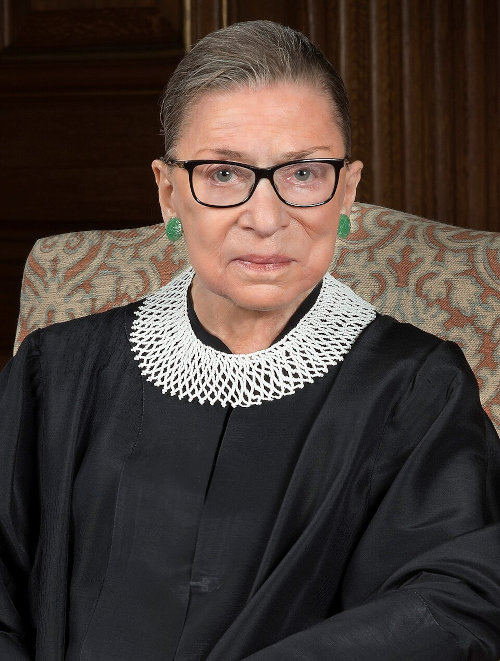
Ruth Bader Ginsburg, affectionately known as RBG, was a towering figure in American law and a cultural icon who changed the course of U.S. history, not through bombast, but through brilliance, grit, and an unyielding commitment to justice. Her life was marked by groundbreaking achievements, quiet but fierce advocacy for gender equality, and a resilience that bordered on the superhuman. Though small in stature at 5’1″ (155cm), her influence was immense.
Early Life and Education
Joan Ruth Bader was born on March 15, 1933, in Brooklyn, New York, to Nathan and Celia Bader. She was the second daughter of a working-class Jewish family. Her mother, Celia, had a deep love for education but was unable to attend college herself. She instilled that passion in Ruth, taking her to the library weekly and encouraging her to pursue her dreams, even when society had different expectations for women.
A tragedy struck young Ruth when her beloved mother died of cancer the day before Ruth’s high school graduation. Though grief-stricken, Ruth went on to attend Cornell University on a full scholarship, where she met Martin Ginsburg, a charming, humorous economics major. She graduated in 1954 as the highest-ranking female student in her class.
Marriage and Harvard Law
Ruth married Martin shortly after graduating and gave birth to their first child, Jane, while Martin was in the Army. After his service, both enrolled at Harvard Law School. Ruth was one of just nine women in a class of over 500. The women were even asked by the dean to justify why they were taking a man’s place.
But Ruth thrived. When Martin fell seriously ill with testicular cancer, she attended all his classes, typed his notes, cared for their daughter, and kept up with her own studies. After Martin recovered and got a job in New York, Ruth transferred to Columbia Law School and graduated in 1959 at the top of her class.
A Brilliant Legal Mind Ignored
Despite her stellar academic record, Ruth struggled to find a job. No one wanted to hire a woman lawyer—especially one who was also a mother. She eventually clerked for Judge Edmund Palmieri and then joined the faculty at Rutgers Law School, where she was paid less than her male colleagues. When she discovered this, she joined an equal-pay campaign with other women professors. That was just the beginning.
Becoming a Gender Equality Warrior
In the 1970s, Ginsburg became the architect of the legal fight for women’s rights. She co-founded the Women’s Rights Project at the ACLU and methodically dismantled laws that treated women as inferior. Cleverly, she chose cases in which men were discriminated against, like a widower denied Social Security benefits because he was a man, forcing the male-dominated courts to understand the perils of gender bias.
Between 1973 and 1978, Ginsburg argued six landmark cases before the U.S. Supreme Court—and won five of them. Her legal strategy was incremental but brilliant, modeled after Thurgood Marshall’s civil rights tactics. She didn’t demand revolution; she built it piece by piece.
Fun Fact: RBG’s legal writing was so measured and precise that some clerks referred to her as the “Yoda of the legal world.” Her motto: “Be brief, be pointed.”
Appointment to the Bench
In 1980, President Jimmy Carter appointed Ginsburg to the U.S. Court of Appeals for the D.C. Circuit. Thirteen years later, President Bill Clinton nominated her to the Supreme Court. At her confirmation hearings, she wowed senators with her intellect, candor, and legal expertise. She was confirmed by a vote of 96-3 and became only the second woman (after Sandra Day O’Connor) to serve on the U.S. Supreme Court.
On the Supreme Court
On the Court, Ginsburg was known for her restrained and methodical approach. In majority opinions, she upheld civil rights and women’s rights with clarity and quiet power. As the Court became more conservative, she often found herself in the minority. That’s when her dissents began to shine.
Her dissent in Ledbetter v. Goodyear Tire & Rubber Co. (2007) argued against a majority decision that made it harder for women to sue for wage discrimination. That dissent was so compelling that Congress later passed the Lilly Ledbetter Fair Pay Act, the first bill signed into law by President Obama.
Fun Fact: Ginsburg's powerful dissents earned her a nickname from a New York University law student: “The Notorious R.B.G.” It was a humorous play on the name of rapper The Notorious B.I.G.—a fellow Brooklyn native. Ginsburg loved it and embraced the nickname.
Pop Culture Icon
In her later years, RBG became an unlikely pop culture sensation. She appeared in documentaries, was portrayed in films, had books written about her, and was even the subject of action figures, coloring books, and Halloween costumes. Young people admired her for her toughness, her intellect, and her fight for justice. She once said, “I’m 84 years old and everyone wants to take a picture with me.”
Fun Fact: RBG was a fitness enthusiast well into her 80s. She worked out twice a week with a personal trainer, doing planks, push-ups, and weightlifting. Her trainer even wrote a book called The RBG Workout.
Personal Life
Ruth and Martin Ginsburg had a famously devoted marriage. Marty, a successful tax attorney and gourmet cook, was her biggest fan. He often said, “My wife doesn’t give me any advice about cooking, and I don’t give her any advice about the law.” He proudly supported her career and urged President Clinton to nominate her to the Supreme Court. They were married for 56 years until Marty’s death in 2010.
Their son, James, is a music producer, and daughter Jane is a law professor at Columbia. Ruth often spoke about the importance of balance, humor, and support in her life and career.
Health Battles and Relentless Spirit
Ginsburg survived multiple bouts of cancer: colon cancer in 1999, pancreatic cancer in 2009, lung cancer in 2018, and liver cancer in 2020. She rarely missed a day on the bench and once participated in oral arguments just days after surgery.
Even while undergoing chemotherapy, she continued to write opinions, train with her fitness coach, and vow to serve “as long as I can do the job full steam.”
Death and Legacy
Ruth Bader Ginsburg died on September 18, 2020, at the age of 87, due to complications from pancreatic cancer. Her death, just weeks before the 2020 election, set off a political firestorm. But the nation mourned her as a hero.
She was the first woman and the first Jewish person to lie in state at the U.S. Capitol. Thousands of people—many in “Notorious R.B.G.” T-shirts—lined up to pay their respects.
Legacy
Ginsburg’s impact on American life is immeasurable. Her legal victories changed the rights of millions. Her dissents inspired a new generation of feminists and activists. Her example proved that one person, using intellect and principle, can profoundly change the world.
She once said, “Fight for the things that you care about, but do it in a way that will lead others to join you.” That philosophy was the heart of her life—and it’s why she remains an enduring symbol of justice, dignity, and determination.
Final Fun Fact: RBG was a fan of opera and even appeared on stage in a non-speaking role in The Daughter of the Regiment. She said if she hadn’t been a lawyer, she might have become an opera singer—though she admitted she had “a grade B voice.”

