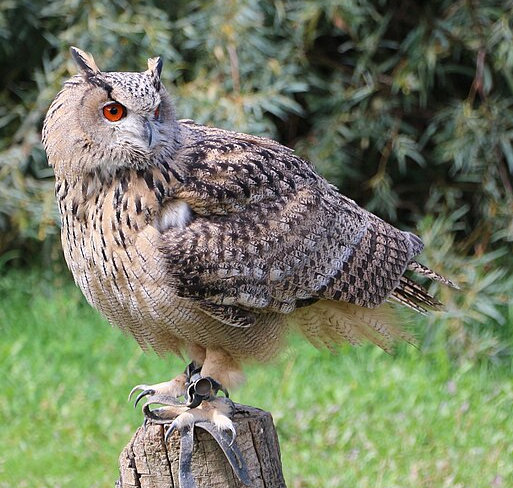
Owls have eyeballs shaped like tubes, not spheres. This means they can’t move their eyes—so they rotate their heads instead.
They can rotate their heads up to 270 degrees thanks to 14 neck vertebrae (humans have 7).
Owls’ ears are asymmetrical. One is higher than the other, allowing pinpoint accuracy in locating prey by sound.
They have feathered legs. Some owl species have fluffy feathers all the way down to their talons.
An owl’s face works like a satellite dish, funneling sound to its ears.
Their eyes are bigger than their brains. In many owl species, the eyes take up most of the skull.
They have three eyelids per eye: one for blinking, one for sleeping, and one for cleaning.
Owls have zygodactyl feet, meaning two toes point forward and two backward—perfect for grasping prey.
Owls’ bones are incredibly light and full of air. That helps with silent flight—but it also means their skeletons are fragile.
They don’t have a crop. Unlike many birds, owls don’t store food in a separate pouch—it goes straight to the stomach.
Owls swallow prey whole, then regurgitate indigestible parts like bones and fur in compact pellets.
Owl pellets are used in school biology classes to study animal anatomy, because they often contain nearly complete skeletons.
They can hear a mouse under a foot of snow.
Some owls have been known to use tools, like using sticks or bait to lure prey.
Not all owls are nocturnal. Some, like the Northern Hawk Owl, hunt during the day.
Owls are mostly solitary. Some pair up for life, but most are extremely territorial and antisocial.
Owls are silent killers. Their specialized wing feathers muffle sound so they can sneak up on prey undetected.
They can fly inches from your ear and you won’t hear it.
Young owls “branch” before flying. They climb and hop between branches before learning to fly.
Owlets sometimes hiss or scream like a snake to scare away predators.
There are over 250 species of owls found on every continent except Antarctica.
The Elf Owl is the smallest owl—only 5 inches (12.7 cm) tall and weighs less than a golf ball.
The Blakiston’s Fish Owl is the largest owl, with a 6-foot (2 meter) wingspan.
Owls nest in surprising places— including cactus holes, termite mounds, and abandoned vehicles.
The Barn Owl has one of the most eerie calls, a screech, not a hoot.
Ancient Romans believed owls were omens of death.
Owls can play dead when cornered. The Japanese Scops Owl flattens its body to look like a tree branch.
In some African cultures, owls are considered witches in disguise.
Owls are illegal to keep as pets in the U.S. without special licenses, despite their portrayal in pop culture.
Owls have been trained for falconry, though they’re generally too stubborn and independent to be reliable.

