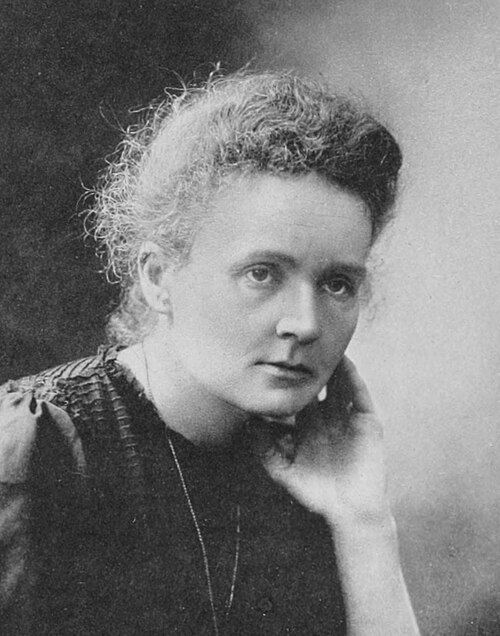
Marie Curie: The Radiant Life of a Scientific Pioneer
Marie Curie was not just a scientist, she was a revolution in human form. Born Maria Salomea Skłodowska in Warsaw, Poland, on November 7, 1867, she would go on to become the first woman to win a Nobel Prize, the only person to win Nobel Prizes in two different scientific fields, and one of the most influential figures in science history. Her story is not only one of intellect and perseverance, but also of danger, love, tragedy, and even a touch of radioactive oddity.
A Brilliant Beginning in Partitioned Poland
Marie was the youngest of five children in a family of educators. Her father taught math and physics, and her mother was a headmistress, but life in Poland under Russian occupation was hard. After losing her mother to tuberculosis at age 10 and her sister to typhus, young Maria grew up in a world shaped by hardship and intellectual rebellion.
Women were not allowed to attend university in Russian-ruled Poland, so Maria became involved in the Flying University, an underground network of classes for women. She worked as a governess to support herself and save money for further education. During this time, she fell in love with a Polish mathematician, Kazimierz Żorawski, but his aristocratic parents forbade the match. Heartbroken but undeterred, she eventually made her way to Paris in 1891, where she adopted the French version of her name: Marie.
Paris, Physics, and Partnership
In Paris, Curie enrolled at the Sorbonne, where she lived on little more than tea and bread, often fainting from hunger but finishing at the top of her class in physics in 1893, and mathematics in 1894.
That same year, she met Pierre Curie, a fellow scientist who recognized her brilliance. The two married in 1895, bonding over science and shared idealism. Rather than a diamond ring, Pierre gave Marie a bicycle, which they used on their rustic honeymoon, an unusual but fitting symbol of their egalitarian and unconventional union.
The Discovery That Glowed
Marie began studying uranium, inspired by the recent discovery of X-rays and Henri Becquerel’s work on radioactive properties. She coined the term “radioactivity,” and, in her meticulous research, discovered two new radioactive elements: polonium (named after her beloved Poland) and radium (from the Latin radius, meaning “ray”).
In a time when lab work was laborious and unglamorous, Marie and Pierre processed tons of pitchblende (a uranium-rich ore) by hand, boiling it down in an abandoned shed with no ventilation. The Curies often worked without gloves or protective gear, unknowingly exposing themselves to dangerous radiation.
Fun fact: Marie Curie’s notebooks are still radioactive—over a century later, they are kept in lead-lined boxes at the Bibliothèque nationale de France. Visitors must sign waivers and wear protective gear to consult them.
Fame, Tragedy, and Firsts
In 1903, Marie and Pierre Curie, along with Henri Becquerel, were awarded the Nobel Prize in Physics—making Marie the first woman to win a Nobel. At first, the Nobel committee intended to honor only Pierre and Becquerel, but Pierre insisted that Marie be credited as an equal contributor. Her scientific merit, not her gender, deserved the spotlight.
Tragedy struck in 1906 when Pierre was killed in a street accident, run over by a horse-drawn carriage. Marie was devastated but persevered. In an almost unheard-of move for a woman at the time, she was offered and accepted Pierre’s professorship at the Sorbonne, becoming the first female professor in the university’s history.
In 1911, she received her second Nobel Prize, this time in Chemistry, for her discovery and isolation of radium and polonium. This remains an unmatched achievement: no other person has won Nobel Prizes in two scientific disciplines.
Strange But True: The Radium Craze
Curie’s discoveries triggered a bizarre public fascination with radium. People believed it had mystical healing properties. It was added to cosmetics, toothpaste, water, and even radium-laced chocolate bars. There were “glow-in-the-dark” parties, and one company sold a product called Radithor, essentially radium in water, promoted as a cure-all.
One tragic result was the case of the “Radium Girls.” They were young women who painted watch dials with luminous radium paint and were encouraged to lick their brushes to keep the tips fine. Many died of radiation poisoning.
Ironically, while Marie Curie remained skeptical of commercialized radium, she carried test tubes of it in her pocket for experiments. Her clothes reportedly glowed faintly in the dark.
World War and Humanitarianism
During World War I, Curie saw a practical use for her discoveries. She developed mobile X-ray units called “Little Curies” and trained medical staff to operate them. These vehicles saved countless lives by helping battlefield doctors locate shrapnel and broken bones.
She even drove one of these X-ray cars herself to the front lines, without a driver’s license or formal medical training. That was a gutsy move for any woman, let alone a Nobel-winning physicist.
Later Life and Legacy
Curie spent her later years founding the Radium Institute (now Curie Institute) in Paris, a world-class center for medical research. Her health, however, deteriorated from long-term exposure to radiation. She died in 1934 at the age of 66, of aplastic anemia, a condition linked to radiation exposure. At the time, the dangers of radioactivity were still poorly understood.
Despite the risks, she never patented her discoveries, believing that science should benefit humanity. “Radium is not to enrich anyone. It is an element. It belongs to all people.”
In 1995, Marie and Pierre Curie’s remains were transferred to the Panthéon in Paris—France’s national mausoleum for heroes. Marie became the first woman to be entombed there based on her own merits.
Curie’s Legacy Burns Bright
Marie Curie’s legacy goes far beyond the laboratory. She broke gender barriers, challenged academic norms, and fundamentally changed our understanding of matter and energy. She inspired generations of scientists, especially women in STEM fields, by proving that brilliance knows no gender.
Odd But True Facts
She refused medals and awards in her later years, believing the work mattered more than the recognition.
She carried out much of her work in a wooden shed with a leaky roof and no insulation, describing the conditions as “a cross between a stable and a potato cellar.”
Albert Einstein once said of her, “Marie Curie is, of all celebrated beings, the only one whom fame has not corrupted.”

